
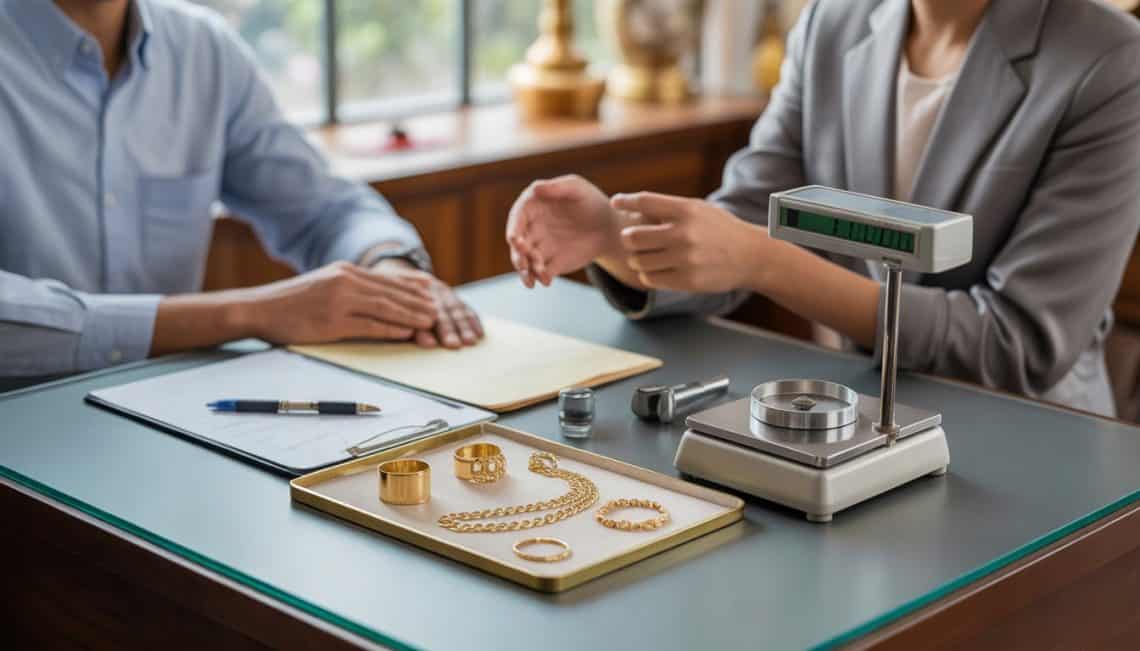
How gold pawn shops work
Pawn vs sell vs consign — choose the right option
A gold pawn shop usually gives three main routes: pawn, sell, or sometimes consign. Pawning means the owner leaves the gold as collateral for a loan and can get it back after repaying the money plus fees. Selling means the gold changes hands permanently for an agreed cash amount. Consigning is less common for plain bullion but may apply to higher-value jewellery, where the shop displays the item and takes a commission after it sells.
Each option has pros and cons. Pawning can be useful when cash is needed quickly but the item is still wanted later. Selling may bring a cleaner outcome if the owner no longer needs the gold. Consigning can sometimes achieve a better selling price, but it may take longer and is not guaranteed. A beginner-friendly rule is simple: pawn for temporary cash flow, sell for final exit, and consign only when the item has strong resale appeal. Related source: AIENB Kedai Emas Pajak Gadai.
How pawn loans are calculated (loan-to-value, interest, term)
Pawn loans are usually based on loan-to-value, or LTV. The shop estimates the resale value of the gold and then offers only a portion of that amount as a loan. This buffer helps the shop cover price changes, storage, and the risk that the item is not redeemed. Gold jewellery often receives a lower percentage than pure gold bars because it may require more testing, sorting, and resale work.
Interest, service charges, and the loan term all matter. The borrower pays to keep the loan active, and if repayment is missed, the shop can eventually take ownership of the item under the contract terms. The exact structure varies by place, so the customer should read the redemption date, grace period, and total amount due before agreeing. According to the Federal Trade Commission, pawn transactions are governed by state laws in the United States, and terms can vary widely by shop and location. [1]
Required ID, paperwork and regulatory basics
Most reputable pawn shops will ask for a government-issued ID and basic contact details. This is partly for compliance and partly to help trace items if there is a later dispute. Customers may also be asked to sign a contract that lists the item description, weight, amount loaned or paid, due date, charges, and the shop’s conditions for redemption or sale.
Regulatory basics are important because pawn shops often have record-keeping duties, waiting periods, and rules on suspected stolen goods. Good paperwork protects both sides. The customer should keep copies of every receipt, ticket, and terms sheet. If the shop does not explain the paperwork clearly, that is a warning sign that the transaction may be less transparent than it should be. [1]
Finding a reputable gold pawn shop
Licenses, signage and customer reviews to check
A trustworthy gold pawn shop usually looks properly licensed, has clear business signage, and displays its operating details in a visible way. Clean premises are not proof of honesty on their own, but they do show basic professionalism. Customers should also check whether the shop provides a proper receipt and whether staff are willing to explain the process without rushing the decision.
Online reviews can help, but they should be read carefully. A few bad reviews are normal for any business, yet repeated complaints about hidden fees, rude staff, or changing quotes deserve attention. It is also sensible to compare reviews from multiple platforms rather than relying on just one source. Consistent patterns matter more than one dramatic story.
Questions to ask before you transact
Before handing over any gold, it helps to ask direct questions. The customer can ask how the shop tests gold, what purity they pay for, how the final price is calculated, and whether the offer includes any deductions for stones, clasps, or repairs. If the item is being pawned, it is also wise to ask about interest, renewal options, grace periods, and what happens if payment is late.
Good shops answer clearly and do not become defensive. If the staff refuse to explain terms or pressure the customer to decide immediately, that is a warning sign. A respectable shop should be able to explain its offer in plain language and allow time for comparison shopping.
Using local directories, trade associations and online platforms
Local directories, trade association listings, and map services can be useful starting points when searching for a gold pawn shop. These sources can help identify shops that are established in the area and easy to reach. Trade association membership may also indicate a stronger commitment to industry standards, though it is still wise to verify everything independently.
Online platforms are most helpful when they are used as screening tools rather than final proof. Customers can compare opening hours, review trends, and service descriptions, then visit the shop in person for the final check. This combination of online research and face-to-face inspection is often the safest approach.
How pawn shops value gold
Understanding purity (karat, fineness) and weight
Gold value starts with purity and weight. Karat is the common jewellery measure, with 24k being near-pure gold and lower karats containing more alloy metals. Fineness is another way of showing the same idea, usually as a three-digit or four-digit number, such as 999 for very pure gold or 750 for 18k gold. The higher the purity, the more gold content the item contains.
Weight matters just as much. A larger item with low purity may still contain less actual gold than a smaller item with high purity. A pawn shop will typically estimate the gold content by combining the item’s weight with its karat or fineness, then applying a market-based calculation. For customers, understanding this basic formula helps explain why a chunky-looking piece may not always receive a huge offer.
Common testing methods (acid test, electronic tester, XRF)
Pawn shops use several methods to check whether gold is genuine and to estimate purity. An acid test uses chemicals and a touchstone to compare how the metal reacts. An electronic tester measures conductivity or resistance and can give a quick reading. A more advanced option is XRF, or X-ray fluorescence, which analyses surface composition without damaging the item.
Each method has pros and cons. Acid tests are affordable but can be less precise on plated or mixed items. Electronic testers are fast, but results can vary depending on design and calibration. XRF is often more detailed, but the equipment is expensive and may not be available in every shop. For that reason, a customer should not be surprised if the shop combines methods before making an offer.
How spot price, condition and markup affect offers
The spot price of gold is a major driver of any offer, but it is not the only factor. Pawn shops still need margin to cover rent, labour, storage, risk, testing, and resale time. That means the offer will usually be below the live market value of the metal content. This can feel disappointing, but it is normal in the pawn industry.
Condition also matters, especially for jewellery. If the piece is bent, broken, heavily scratched, or missing stones, the resale value may fall even if the gold content is solid. Some shops also adjust offers based on how easy the item is to resell locally. A simple gold chain may move faster than a large, unusual design. Understanding these tradeoffs helps set realistic expectations before visiting the shop.
Getting the best price when selling or pawning gold
Prepare items: cleaning, receipts, original paperwork and provenance
Preparation can improve both confidence and bargaining power. Before visiting a gold pawn shop, the customer should gather receipts, certificates, original boxes, and any appraisal documents. These items do not always raise the metal value directly, but they can support authenticity and help the shop assess the item faster. If the gold has a known origin, such as a branded piece or inherited jewellery with paperwork, that background may also help.
Cleaning should be done gently. The goal is to remove obvious dirt, not to polish away marks or damage the piece. Harsh cleaning can scratch soft gold or loosen stones. A soft cloth and mild care are usually enough. A well-presented item can sometimes make a better impression, even when the offer still depends mainly on weight and purity.
Timing your sale around spot price and market trends
Gold prices move over time, so timing can make a difference. When spot prices rise, offers may improve because the underlying metal value is stronger. Customers who are not in a hurry may want to watch the trend for a few days or compare quotes across different periods. Even a small change in price can matter for heavier pieces.
That said, timing should stay realistic. No one can predict the market perfectly, and small daily swings are normal. If cash is urgently needed, waiting for an ideal price may not be practical. The better approach is to know the current market, then decide whether the timing is good enough for the person’s needs.
Negotiation tactics and realistic price expectations
Negotiation works best when it stays polite and informed. The customer can ask how the quote was calculated, whether the shop can improve the offer, and if a second item would be priced differently. Bringing competing quotes from other shops may also help, as long as the comparison is fair and based on similar purity and weight estimates.
Realistic expectations are essential. Pawn shops need room for profit, so they rarely pay full retail value. The best outcome is usually not the highest possible number in theory, but a fair offer that is explained clearly and paid promptly. Customers who understand the resale model are less likely to feel short-changed and more likely to make a calm decision.
Buying gold from a pawn shop
Why pawn shops can offer lower prices (inventory sources & margins)
Buying from a gold pawn shop can be attractive because prices are often below jewellery-store retail. Pawn shops acquire inventory from pawned items, direct sales, and local trade-ins, so they may be willing to price items competitively to move stock. Lower overhead than some traditional retailers can also support better deals for buyers.
However, lower price does not automatically mean better value. The shop still needs margin for cleaning, testing, repairs, and the risk that an item sits unsold. Buyers should therefore compare the offered price with the item’s condition and market price, not just with a new retail tag. A bargain is only useful if the item is genuine and suitable for the buyer’s needs.
What to inspect: authenticity, damage, repairs and hallmarking
When buying gold, authenticity is the first concern. Buyers should look for hallmarking, karat stamps, and any supporting documentation. They should also inspect clasps, links, prongs, and settings for damage or poor repairs. If the piece contains gemstones, the buyer should check whether stones are secure and whether any replacements are obvious.
Condition matters because repairs can cost more than expected. Signs of soldering, uneven colour, or worn edges may suggest past damage. A careful inspection under good light is worth the time. If the shop allows, the buyer may also ask to weigh the item or see the testing result before committing.
Return policies, warranties and negotiating the purchase price
Return policies vary a lot between pawn shops. Some offer short return windows, while others sell items as-is. Buyers should ask about returns before paying, because jewellery and gold items can be difficult to value after the fact. Warranties are also not always standard, so the buyer should not assume there is any protection unless it is written clearly.
Negotiating is often possible, especially if the buyer spots a flaw, a repair issue, or a lack of documentation. A respectful offer backed by specific observations is usually more effective than a vague request for a discount. As with selling, the best strategy is to combine patience, a clear understanding of value, and a willingness to walk away if the deal does not feel right.
Costs, fees and legal considerations
Interest, storage, service fees and forfeiture rules
When using a gold pawn shop, the headline amount is only part of the cost. Interest charges, storage fees, and service fees can accumulate over time. In pawn transactions, these recurring costs are often what make the difference between a manageable short-term loan and an expensive one. The customer should ask for the total amount due by the redemption date, not just the initial loan sum.
Forfeiture rules are equally important. If the borrower does not repay within the required period, the shop may have the right to keep and later sell the item. The exact timing varies by jurisdiction and contract. Customers should treat the pawn ticket like a legal agreement, because in practice it is one. [1]
Tax and reporting considerations (varies by country/region)
Tax treatment for gold sales or pawn transactions depends on the country or region. In some places, selling gold may create reporting duties if the transaction is large enough or if certain items are involved. In others, the main concern may be whether the transaction is treated as a sale, a loan, or a redemption of pledged property. Because the rules differ widely, the customer should not assume one country’s practice applies everywhere.
If the gold was inherited, gifted, or held for a long time, the tax position may be more complex. Keeping records of the purchase price, sale amount, and date can help if questions arise later. When in doubt, it is safer to check local tax guidance rather than guessing.
Legal risks: stolen goods, chain-of-custody and shop responsibilities
Pawn shops have responsibilities when it comes to stolen goods. They are often expected to keep records, verify identity, and cooperate with law enforcement when necessary. This helps create a chain-of-custody trail for items that pass through the business. For honest customers, these safeguards are actually beneficial because they reduce the chance of disputes.
At the same time, customers should be careful not to bring in questionable items. Selling or pawning stolen property can create serious legal problems, even if the person receiving the item does not know its origin. The safest approach is to deal only in gold that can be reasonably shown to belong to the seller or borrower.
Safety, fraud prevention and red flags
Common scams and warning signs to avoid
Common scams in the gold trade include bait-and-switch pricing, fake testing claims, and pressure to accept a rushed deal. A warning sign is when a shop gives one price by phone and then a much lower one after inspection without a clear reason. Another red flag is when staff avoid writing down terms or refuse to give a copy of the agreement.
Customers should also be cautious of suspiciously high quotes that seem far better than other shops. Sometimes the purpose is to lure the customer in before fees or deductions appear. A trusted gold pawn shop will explain why an offer is what it is and will not rely on confusion to close the transaction.
Verifying authenticity with independent tests and appraisals
If an item is valuable, an independent appraisal can provide peace of mind. This can be especially useful for antique jewellery, branded pieces, or items with gemstones. Third-party testing may help confirm purity and condition before selling, pawning, or buying. For many beginners, even a basic appraisal can prevent costly mistakes.
Independent verification is particularly useful if the first quote seems unusually low. A second opinion can reveal whether the item is underweighted, misidentified, or damaged more than expected. The goal is not to challenge every shop, but to create enough confidence to proceed with the right deal.
Secure payment methods and keeping transaction records
Secure payment methods help reduce fraud risk. Cash is common in pawn transactions, but some shops may also offer bank transfers, cards, or digital methods depending on local rules. If a non-cash payment is used, the customer should confirm when funds will clear. Whatever the method, the buyer or seller should receive a proper receipt that matches the amount, date, and item description.
Transaction records are worth keeping for a long time. Photos of the item, copies of ID checks, the pawn ticket, and any appraisal report can all help if a dispute arises later. Good records are a simple but powerful form of protection.
Alternatives to pawn shops
Online gold buyers and peer-to-peer marketplaces
Online gold buyers can be convenient because they allow the seller to request a quote from home. Some provide insured mail-in kits and quick payment after testing. Peer-to-peer marketplaces may also produce a higher sale price if the item is desirable to collectors or end users. These options can sometimes beat pawn-shop offers, especially for branded or fashionable pieces.
Still, online and peer-to-peer sales come with their own risks. Shipping loss, buyer disputes, scams, and platform fees can eat into the final amount. A pawn shop may pay less, but it also offers immediacy and a face-to-face transaction. The better choice depends on whether the person values speed, simplicity, or maximum resale potential.
Jewelry stores, coin dealers and pawn-shop tradeoffs
Jewellery stores may buy certain pieces, especially if they believe the item can be resold quickly or remade. Coin dealers are often better suited to gold coins and bullion, while pawn shops handle a wide range of gold items. Each channel has tradeoffs in pricing, expertise, and convenience. A specialty buyer may pay more for a specific category than a general pawn shop would.
On the other hand, specialty buyers may reject items that fall outside their preferred inventory. A pawn shop tends to be more flexible, which is useful when the seller wants one-stop service. The customer should compare at least a few options before deciding.
Short-term loans, cash advances and other financing options
If the main goal is quick cash, a pawn loan is only one possibility. Short-term personal loans, employer advances, credit union products, or other financing options may cost less in some cases, though approval may take longer. The right choice depends on credit standing, urgency, and the ability to repay on time.
Compared with other financing, a pawn shop is often simpler because the gold itself secures the deal. That convenience is the main advantage, but it comes with the risk of losing the item if repayment fails. For that reason, borrowers should compare the total cost and not look only at how fast the cash arrives.
Step-by-step checklist to pawn or sell gold
Before you go: research, document and value your items
Before visiting a gold pawn shop, the customer should research current gold prices, compare nearby shops, and gather documents such as receipts, certificates, or prior appraisals. It also helps to weigh the item if a reliable scale is available and to note any stamps or markings. This preparation creates a clearer picture of what the item may be worth.
Photographs are also useful, especially for unique jewellery. They can help if the item is later disputed or if the customer wants to compare offers from several shops. A little preparation usually leads to a smoother and more confident transaction.
At the shop: what tests and questions to insist on
At the shop, the customer should ask how the item will be tested and whether the test is destructive or non-destructive. It is reasonable to ask for the weight, purity estimate, and the reasoning behind the offer. If the item is being pawned, the borrower should also ask for the full repayment amount and the deadline in writing.
These questions are not being difficult; they are simply good practice. A professional shop should welcome them. If the answers are vague or inconsistent, the customer should slow down and consider leaving without completing the deal.
After the transaction: receipts, redemption timeline and dispute steps
After the transaction, the customer should keep every receipt and note the redemption timeline if the item was pawned. The terms should show when payment is due, what happens if the date is missed, and whether there is any extension period. If the item was sold, the receipt should still be kept for proof of the deal.
If a problem arises later, the first step is to return to the shop with the paperwork and ask for clarification. If the issue is not resolved, the customer may need to contact a consumer protection agency or seek legal help, depending on local rules. Good records make disputes much easier to handle.
Local tips and resources
How to find trustworthy local pawn shops and reading reviews
Finding a trustworthy local gold pawn shop usually starts with asking around, checking map listings, and reading recent reviews. The most useful reviews are specific, mentioning prices, staff behaviour, and how clearly the shop explained its terms. A shop with many consistent positive comments is usually a better bet than one with no feedback at all.
Local visits can also reveal a lot. The customer can observe whether the shop is organised, whether the staff answer questions patiently, and whether the quotes seem consistent with market conditions. A quick in-person check often tells more than an hour of online searching.
Consumer protection agencies, trade bodies and legal help
Consumer protection agencies can be helpful when a transaction seems unfair or unclear. Trade bodies may also provide standards, directories, or complaint channels. These organisations are especially useful when the customer needs to understand rights, reporting rules, or dispute options in a specific location.
For serious issues, legal help may be necessary. This is particularly true if the dispute involves stolen goods, a contract problem, or a high-value item. Keeping all records from the start makes it much easier for any agency or lawyer to assess the case.
When to get a professional appraisal or legal advice
A professional appraisal is worth considering when the item is valuable, unusual, antique, or set with stones whose worth may be separate from the gold itself. A legal opinion may be needed when the paperwork is unclear, the shop’s actions seem improper, or the item has a complicated ownership history. In both cases, the extra cost can be justified by the protection it brings.
For most everyday transactions, a simple comparison of offers may be enough. But when the gold piece is emotionally important or financially significant, professional advice can help the customer avoid a rushed mistake. That is often the wisest move when dealing with a gold pawn shop. [1]
[1] Federal Trade Commission, “Pawn Shops” and consumer guidance on pawn transactions, including the importance of understanding loan terms and state-specific rules.

